Education in the Age of Artificial Intelligence: What Skills Will Shape the Future?
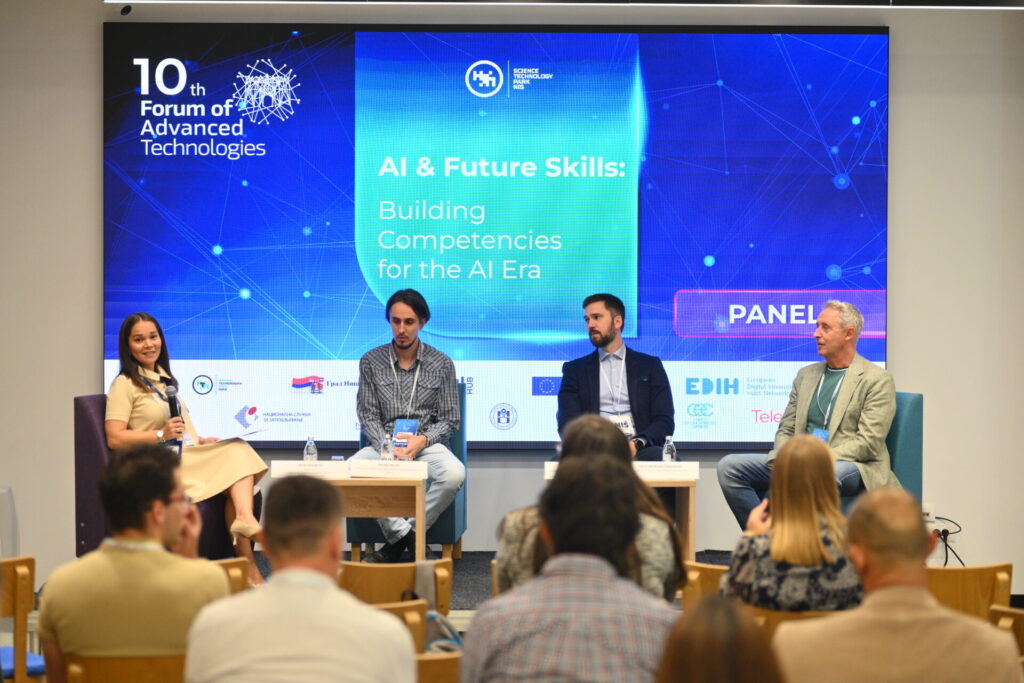
The 10th Forum of Advanced Technologies, held at the Science and Technology Park Niš, provided an opportunity to discuss the future of education and the competencies needed in the age of artificial intelligence. These topics were explored during the “AI & Future Skills: Building Competencies for the AI Era” panel, which brought together representatives of the academic and research communities.
Held under the theme “TechIntelligence: Transforming Industry for the Intelligent Age,” this year’s Forum brought together representatives of technology companies, industry, academia and research, public institutions, the startup ecosystem, and the investment community.
The “AI & Future Skills: Building Competencies for the AI Era” panel was part of the Talent & Career Arena programme segment and was moderated by Dr Jelena Mitić, Research Associate at the Institute for Artificial Intelligence Research and Development of Serbia. The panel featured Milan Grujev, Research Trainee at IVI, Dr Veljko Prodanović, Senior Research Associate at IVI, and Dr Milan Zdravković, Professor at the Faculty of Mechanical Engineering, University of Niš.
The discussion focused on how education can respond to technological change and prepare new generations for an environment in which artificial intelligence is becoming increasingly integrated into professional and everyday activities.
The panelists discussed the skills that are becoming increasingly important, from problem-solving and data literacy to creativity, interdisciplinary thinking, and continuous learning. Particular attention was given to the need for education to go beyond the acquisition of knowledge and proficiency in specific technologies, and to foster the ability to adapt to change and independently acquire new knowledge.
Another important topic was the need for stronger connections between education, research, and industry. The rapid development of artificial intelligence is changing the needs of the labour market, making collaboration between universities, research institutions, and companies increasingly important for identifying emerging needs and developing educational programmes that reflect current demands.
The discussion highlighted that preparing for the AI era requires a broader approach to developing competencies, with technical knowledge representing only one part of the preparation for the future professional environment. Alongside technical expertise, the ability to adapt, connect knowledge across different fields, and engage in continuous learning is becoming increasingly important — skills that enable individuals to respond effectively to the changes brought about by the development of artificial intelligence.