Artificial Intelligence in the Service of Safer and More Resilient Communities
The panel “Artificial Intelligence in the Natural, Technical, and Social Sciences” brought together experts from academia, education, and research to discuss practical applications of artificial intelligence and its impact on society, education, and urban environments. The event provided an opportunity for exchanging experiences, discussing current challenges, and exploring the potential of modern digital technologies in building more resilient communities.
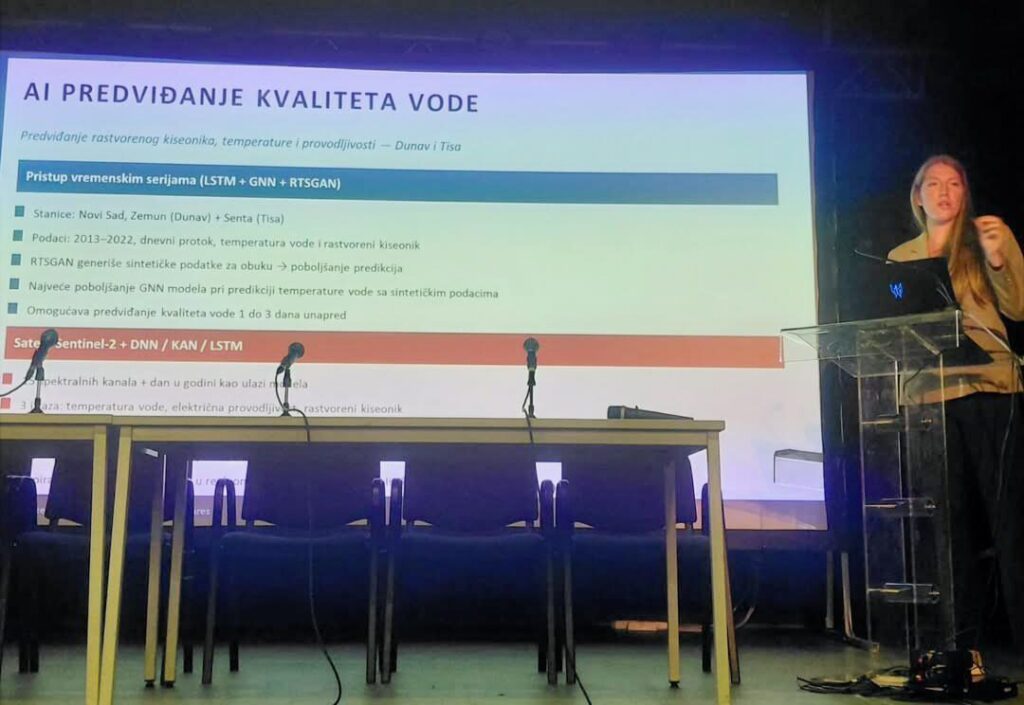
During the panel, Ana Samac, research assistant at the Institute for Artificial Intelligence of Serbia, delivered a lecture titled “Artificial Intelligence for a Safer Future: How Digital Models Protect Cities and Build Citizens’ Trust”. In her presentation, Samac highlighted contemporary applications of AI in environmental protection and risk management, with particular emphasis on the challenges posed by climate change, including increasingly frequent floods and water quality degradation.
Through the presentation of the ARTIFACT project and other similar initiatives, she explained how hydrometeorological, satellite, and ecological data are integrated into systems for real-time flood prediction, optimization of hydroelectric operations, and continuous monitoring of rivers such as the Danube, Drina, and Tisa. Special attention was given to the use of urban flood simulations and the role of green infrastructure in planning more resilient urban environments.
Beyond technological applications, the lecture also emphasized the social and educational dimensions of artificial intelligence. Opportunities for integrating open data and visualizations into the educational process were highlighted, along with the importance of project-based and interdisciplinary learning connecting natural, technical, and social sciences. Climate and infrastructure challenges were recognized as an ideal framework for developing learning models that foster critical thinking and the practical application of knowledge.